
|
To my shame, this was the first time I heard Dvořák's Seventh Symphony. Eschenbach's interpretation was electrifying in its emotional intensity. It imbued the symphony with almost as much tragedy as in Tchaikovsky's “Pathétique.” On a different note, since there are so many random people at the Kennedy Center who enthusiastically clap after the first movement of a concerto or a symphony, I wonder why the Kennedy Center wouldn't make it a policy to play an announcement prior to each performance advising the public that there is no applause in-between the movements. |

|

|
Friday, November 9, 2012
Dvořák's Seventh with Eschenbach/NSO

Wednesday, November 7, 2012
Lang Lang / Christoph Eschenbach piano recital at the Kennedy Center

|
Much more sensible review in the WP than the one for the previous recital. Indeed, “Eschenbach projects a kind of monkish restraint, but he may actually be the more flamboyant, the more emotional of the two. Lang Lang is certainly given to big gestures, but there's also a solid through line, where Eschenbach can be episodic.” “The performance was certainly a heartfelt exchange between two musicians, playing on two equal instruments, facing each other.”And that was strange: while “For Two Pianos” means just that, “For Four Hands” implies sharing the keyboard of the same instrument. Yet, it was only at the very end, with the Debussy encore, when the two musicians actually played on the same piano. Midgette, A., Coming to appreciate Lang Lang, Washington Post, November 8, 2012. |
|

|
Sunday, November 4, 2012
Lang Lang in Mozart/Chopin recital at the Kennedy Center

|
 |
 |
Deceptively simple Mozart's early piano sonatas are among the hardest to “get right.” One of my favorite recordings of Mozart's piano sonatas is that of Claudio Arrau, and he was in his 80's when he made it.
All the more stunning then is the maturity and depth of interpretation shown by 30-year-old Lang Lang. Balance, contrast, and logical flow of movements in each of the three sonatas: thoughtful sound dynamic, from gossamer pianissimo to masculine forte, with all the nuances in between; contemplative, even meditative, approach, as if music fabric is being woven right before your eyes, here and now; and—the sign of true mastery—the musician is not afraid of rests, each extended pause feeling like an intake of breath: the music is alive, and there is no hint of mechanical predictability. It is truly gratifying that the pianist's considerable virtuosity is subordinate to solving a purely musical task: in discovering his Mozart, Lang Lang has managed to reveal facets both Beethovenian and Schubertian. Moreover, the often overlooked introspection in the early Mozart's sonatas is what has bridged two parts of the Sunday's recital, bringing together composers so different as Mozart and Chopin.
Finally, it is impossible not to notice the formidable expressive power of the pianist's left hand, contributing mightily to what Abram Yusfin called “the discernability of musical texture:” the clarity and gravitas of themes played by the left hand sometimes creating a counterpoint to, other times flowing effortlessly into the themes in the right hand. I wouldn't be surprised if the sense of musical form coupled with the expressiveness of his gesture might lead Lang Lang eventually to a conducting career.
Thursday, October 11, 2012
Richard Goode's Bethoven at the Kennedy Center


Battey, R., Pianist Richard Goode performs Beethoven sonatas with sharp inquiry, Washington Post, October 12, 2012.
Saturday, September 29, 2012
Il Trovatore at the Met


Silverman, M., Youth and experience at Met in Verdi's ‘Trovatore’, The Huffington Post, September 30, 2012
Sunday, September 23, 2012
Invisible Man at the Studio Theatre
 Marks, P., Studio Theatre's ‘Invisible Man’ has visual brilliance, compelling performance, Washington Post, September 13, 2012.
Sunday, September 16, 2012
Helanius J. Wilkins in /CLOSE/R at the Dance Place
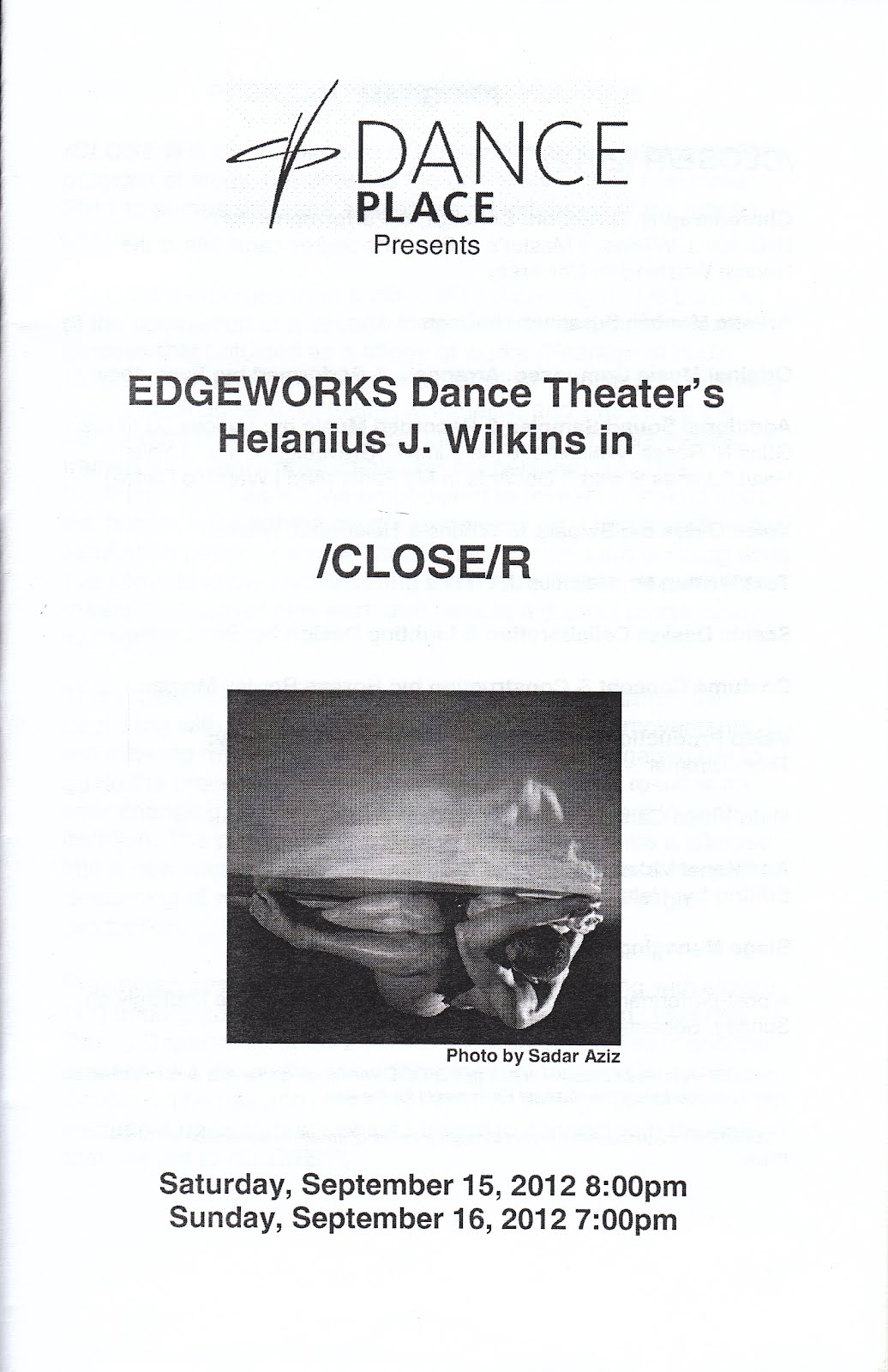 dancers in dialogue: letting go. September 17, 2012
Sunday, July 29, 2012


Thursday, July 5, 2012
Paris Opera Ballet: Giselle

|
I am through with Sarah Kaufman. Kaufman, S. (July 6, 2012), Paris Opera Ballet's ‘Giselle’ soars at Kennedy Center, Washington Post. This is the most inane review I have ever read. “No legs thrown to her ear, no steely poses; she was entirely of the ballet’s time.” To make a quaint, dated, boring spectacle out of Giselle—thank you, Paris Opera Ballet. See you in another 19 years. | |
 |

|

|
Sunday, June 10, 2012


Subscribe to:
Posts (Atom)