
|
To my shame, this was the first time I heard Dvořák's Seventh Symphony. Eschenbach's interpretation was electrifying in its emotional intensity. It imbued the symphony with almost as much tragedy as in Tchaikovsky's “Pathétique.” On a different note, since there are so many random people at the Kennedy Center who enthusiastically clap after the first movement of a concerto or a symphony, I wonder why the Kennedy Center wouldn't make it a policy to play an announcement prior to each performance advising the public that there is no applause in-between the movements. |

|

|
Showing posts with label NSO. Show all posts
Showing posts with label NSO. Show all posts
Friday, November 9, 2012
Dvořák's Seventh with Eschenbach/NSO

Friday, March 4, 2011
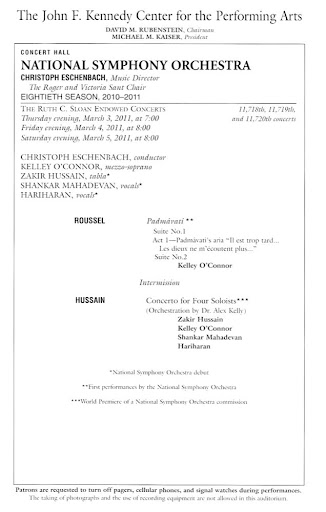
Zakir Hussain and the NSO
|
Midgette, A. (2011) Crossover: NSO goes to India, The Classical Beat, March 4, 2011. Midgette, A. (2011) NSO review: Tabla meets West as ‘India’ concert strikes a crossover convergence, Washington Post, March 4, 2011. |

Friday, January 28, 2011
Berg and Beethoven with NSO/Eschenbach
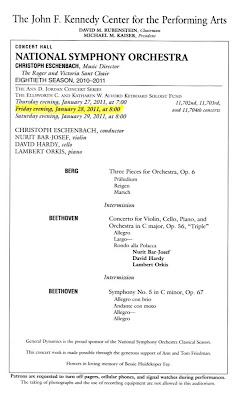
 What a difference a program makes! After the flop with an all-American program, it was so wonderful to hear the all-Viennese one today! The Berg pieces, infused with the sense of foreboding, sounded so fresh as if they were written today. Beethoven's Triplekonzert was something of a disappointment though: in my mind's ear I was hearing the famous Oistrakh/Rostropovich/Richter/Karajan recording with the Berlin Philarmoniker, and even though Lambert Orkis and Christoph Eschenbach were excellent, David Hardy is by no stretch is a Rostropovich; and Nurit Bar-Josef, as nice as her violin sound is, is no Oistrakh.
Eschenbach's take on the Beethoven's 5th was very fresh: the dynamic ranges (ppp/fff, crescendo/diminuendo) was wide, the tempi were unusually fast, and even though he is often criticized for an episodic approach and lack of architectural vision, the symphony's progression from one movement to another seemed logical, and it felt like a unified work.
What he needs to work on, it seems to me, is achieving timbre distinction, juxtaposition, and contrast of various orchestral groups, so that the stringed, the woodwinds, and brass would all have their own distinct sound quality, like what one can hear with Amsterdam Concertgebouw under Haitink and Jasons, Leningrad Philharmonic under Mravinsky, or Philadelphia Orchestra that Eschenbach himself used to lead. In fairness though, acoustics of the Kennedy Center Concert Hall are so bad that some of the sound quality may have been simply dampened or distorted. Yet, what Eschenbach has achieved in his short tenure at the NSO is quite impressive.
Midgette, A., Concert review: Christoph Eschenbach showcases National Symphony Orchestra 'family', Washington Post, January 28, 2010.
Monday, January 24, 2011
Bernstein and Gershwin with NSO/Eschenbach and Barto

Tzimon Barto (once upon a time, just plain Johnny Barto Smith, Jr., from a town near Orlando) is a body-building, multi-lingual, novel-writing keyboard artist who has a long association with Eschenbach in concert halls and recording studios. The conductor hears in the pianist more qualities than some of us do.
I found myself mostly frustrated [...], first by the incredibly slow tempos that kept overriding Gershwin's own energetic pulse; and then by Barto's playing. There were flashes of bravura and of intriguing poetic nuances, but there wasn't quite enough technical dazzle or richness in tone to keep things fully interesting.
Smith, T., National Symphony marks JFK anniversary with new Lieberson work, Baltimore Sun, January 23, 2011.The pianist apparently thinks of the concerto as Gershwin's attempt to out-do Rachmaninoff, an approach Eschenbach embraced with a conviction you had to admire. I'm far more open to extremes than many of my colleagues, and I really wanted to buy into this exercise in elongation, this search for profound depths amidst the Charleston rhythms, but I just kept missing the guy I recognize as Gershwin.
Subscribe to:
Posts (Atom)